
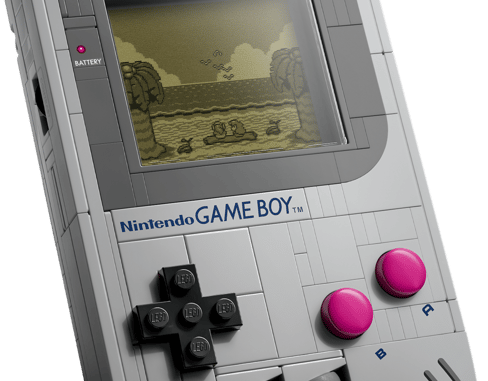
Ever since LEGO started their “adults welcome” push into retro gaming with the NES and the Atari 2600, we’ve been waiting for the handheld king to get the treatment. Well, over 30 years since I used to sit in the back of my parents’ car playing Kirby’s Pinball for hours, it’s finally here. The LEGO Game Boy isn’t just a model that looks like a classic handheld from across the room; it’s a tactile fidget toy that practically demands you pick it up and play with it.
Building the Game Boy is a very relaxing, clearly laid out process. Instructions are clear, the bags are divided up into well-portioned sets of instructions, and it all comes together into a build that you can sit and crack on with for 10 minutes or over an hour, depending on what your schedule allows. You never feel overwhelmed by having to search through a massive pile of tiny pieces, and while the ordering is a little odd at times (the two cartridges themselves are pretty much at opposite ends of the building process) it’s a very well designed, and well thought-out building process.
One of the great things about the final build of this is the button feel. Usually, LEGO buttons are either static or have a clicky snap, but the designers have done something brilliant here. By using small rubber wheels hidden behind the A and B buttons and the D-pad, they’ve managed to replicate that specific, slightly “spongy” resistance of the original 80s hardware. It doesn’t just bottom out; it pushes back. It’s a genius bit of engineering that makes the whole build feel like a living piece of tech rather than just a plastic shell.
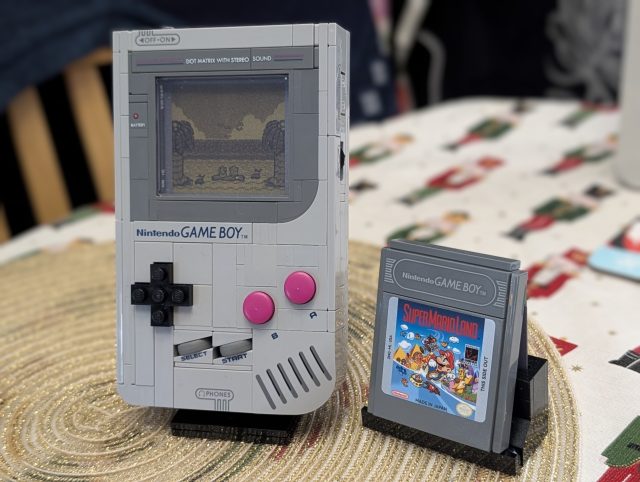
The customisation here is spot on as well. You get the two aforementioned brick-built cartridges: Super Mario Land and The Legend of Zelda: Link’s Awakening. They aren’t just grey blocks, either… the circuit boards inside each cartridge are built with different layouts to reflect the actual complexity of the original carts. Link’s Awakening even features a tiny 1×1 circular tile to represent the internal battery used for save games, which considering you’ll only really see that while building is one of those beautiful “if you know, you know” secrets that belong to the builder alone.
But the real magic is the holographic lenticular screens. You get three different panels (Mario, Zelda, and that wonderful scrolling Nintendo startup screen) that you can swap out by simply flicking the back off the unit. Because they’re lenticular, as you tilt the Game Boy the image shifts, perfectly mimicking that lo-fi, ghosting green Dot Matrix display we all remember squinting at in the back of a car while desperately hoping another streetlight rocks up soon.
There are a few fiddly parts of the build that help you to understand the older audience. There’s a working volume slider and a contrast dial on the sides that use some clever friction to give them a satisfying feel, one that’s bizarrely similar to the real deal. In addition to that, the on/off switch at the top actually clicks into place which is incredibly satisfying, though sadly it won’t light up a red LED… not a game breaker, but it would’ve been extremely cool to have had a light brick making it look actually switched on!
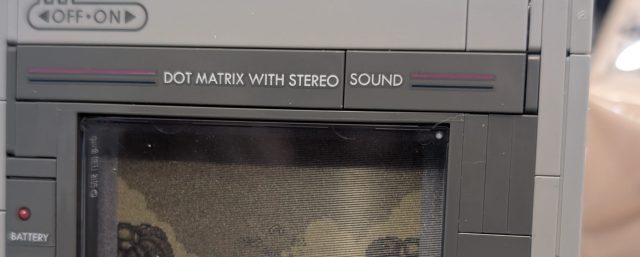
No help things look as good as possible, almost every detail, from the “Dot Matrix Game” branding to the speaker grille, is printed. Aside from the stickers on the game cartridges (which actually feels right, as the real cartridges had stickers) there isn’t a single fiddly decal to misalign on the main console. That sounds great, and it’s one less thing to think about, but there was an unfortunate misalignment at the top, with “stereo sound” not quite lining up across the two different pieces. It’s not going to make you instantly hate the end result, but it’s a little annoying once you’ve noticed it.
But at 421 pieces and roughly £55, this is easily one of the best value-for-money sets in the current Nintendo range. It’s a 1:1 scale replica that fits perfectly in your hand and uses some of the most “outside the box” techniques I’ve seen in years to nail the feel of the original.
Whether you’re displaying it on the included minimalist stand or just keeping it on your desk to fiddle with the D-pad during Zoom calls, this is a must-have for gamers or anyone who has fond memories of gaming in the early 90s. It’s a beautiful, meditative build that proves you don’t need 3,000 pieces to create something truly special.