
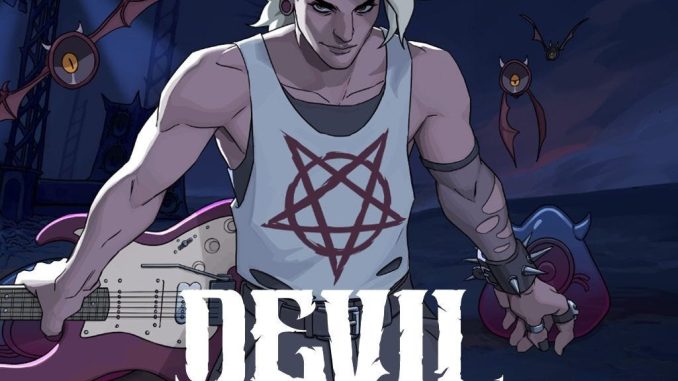
I wasn’t entirely sure what Devil Jam was going for at first. It throws you in, things are already moving, music’s doing its thing, and apart from a brief blink-and-miss-it tutorial, you’re sort of expected to figure it out as you go. Give it a bit of time though, and it starts to click…
At a basic level, it’s quite similar to Vampire Survivors. You’re moving around an arena, dealing with waves of enemies, picking up upgrades and gradually becoming more powerful the longer you survive. The difference here is that everything is tied into the music, and that changes how you approach it quite a bit.
The main idea is built around assigning powers to beats in a bar, so instead of just reacting to what’s happening, you’re shaping what happens each time the loop comes back around. Get a few things lined up, let it run, and suddenly everything starts going off in sync. It very quickly turns into a set-it-up-and-let-it-rip-em-up (it’ll catch on), especially once you’ve got a few layers working together.
That’s easily the best part of it. When it all lines up, it feels great. You’re not just reacting, you’re building something that plays itself back in a way that actually makes sense. There’s a nice bit of trial and error to it as well, figuring out what works and what just turns everything into chaos, and trying to plan ahead to link up the various power-ups becomes something far more than just chucking a power-up wherever you want.
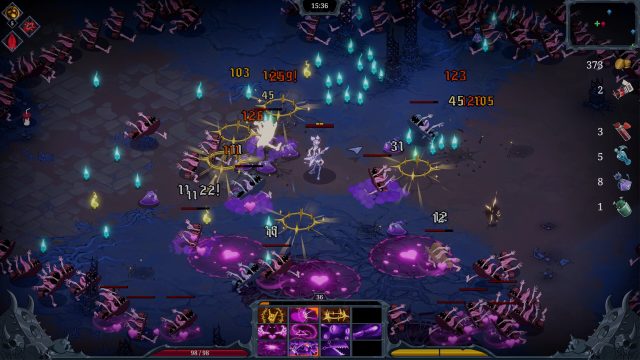
It’s not the easiest thing to get your head around straight away, though. Early on, it can feel a bit like you’re just placing things and hoping for the best. It takes a little while before you properly understand how your choices affect what happens when the loop repeats, and how to use the highlighted beat patters to increase the effectiveness of your attacks, but once it clicks, it clicks, and from that point on everything steps itself up a notch. You’ll also find a sequence of missions to complete as well, but while these are a nice way to give some direction to what you’re doing, they don’t set the game alight beyond providing a few upgrades. That said, I’d rather have them than not.
Visually, it leans into that loud, slightly chaotic style you’d expect from something this music-focused. There’s a lot happening on screen once everything gets going, and while it can be a bit much at times, it suits what the game is trying to do. Half the time I found myself just running away and trying to find a gap, not really paying much attention to the chaos unfolding around me… exactly how I used to play Vampire Survivors, actually.
What I like as much as anything else though is how easy it is to just jump in and mess about. You can play for a short burst, try a few different setups, and see what works. It doesn’t feel rigid, which helps a lot given how experimental it can be.
That said, there are definitely moments where it tips a bit too far into chaos. Sometimes it’s hard to tell if something didn’t work because of your setup or because everything just got a bit out of hand. A bit more clarity in those moments would go a long way, and it’s not hugely likely you’ll get chance to try the same setup in multiple consecutive games, which again dips into the trial and error bracket at times.
Still, when it does come together, it’s a really satisfying mix of rhythm and action. It’s doing something a bit different, and for the most part, it pulls it off. If you like something like Vampire Survivors but fancy a twist that leans into music and a bit more creativity, there’s a lot to like here, but it’s not breaking a huge amount of ground beyond the music twist.
Reviewed on PS5