
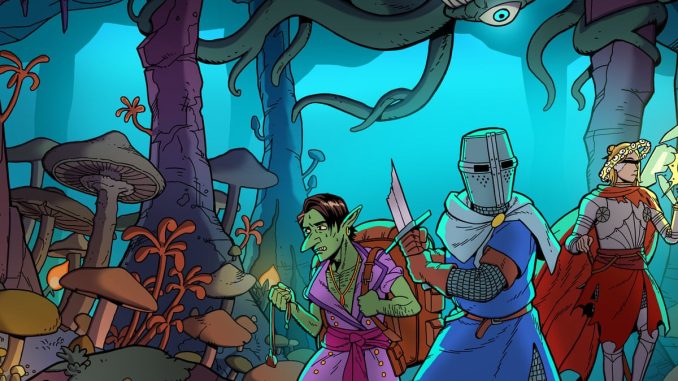
You wake up in a morgue, freshly pulled from a river, not quite dead, and immediately in over your head. Welcome to Norvik, and congratulations, you’re the cleric they’ve sent to solve whatever the hell’s going on.
I adored Disco Elysium. Properly, obsessively adored it, to the point where I’ll admit I sat down with Esoteric Ebb half braced to be disappointed by the comparison everyone’s already made. I wasn’t.
Esoteric Ebb is a single-player CRPG from solo developer Christoffer Bodegard, and it wears its Disco Elysium inspiration proudly: dialogue-first, skill-check-heavy, with your own stats chiming in on conversations like a chorus of increasingly unhinged advisors. The setup has you investigating a tea shop bombing days before Norvik’s first ever election, a city on the Esoteric Coast still finding its feet after a magical war, with your goblin companion Snell along for moral support and the occasional withering aside. It’s not chasing Disco’s exact register, all post-Soviet melancholy and washed-up detective ennui, it’s playing in a much sillier fantasy sandbox, but the bones underneath, that sense of your own skills bickering with each other in your head, are unmistakably from the same family.
Character creation is proper tabletop stuff. Every stat you neglect will find a way to humiliate you later, whether that’s a Strength check on a stuck door or a Dexterity roll on something as basic as climbing down a ladder. I built mine leaning hard into Charisma and Intelligence and paid for it constantly, in a good way; there’s real pleasure in a game that lets you build a character who’s brilliant at talking their way into trouble and hopeless at getting back out of it. The dice are visible and honest about it too, so when a roll goes badly you’re never left wondering whether the game stitched you up or you just built your cleric wrong from the outset.
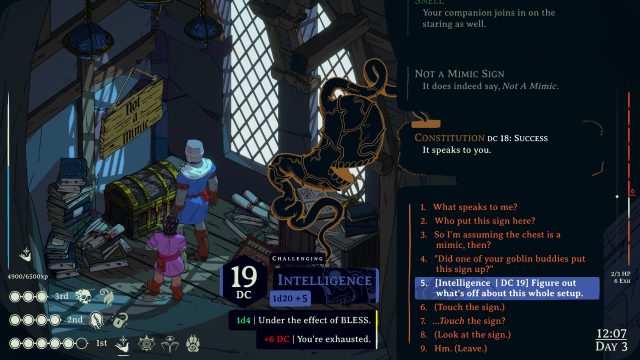
Norvik itself is doing a lot of the work here. It’s a city trying to hold itself together in the aftermath of a war fought with magic rather than muskets, now lurching towards its first ever democratic election, and every side conversation seems to have an opinion on how that’s going. Snell, your goblin companion, ping-pongs between genuine warmth and biting sarcasm depending on how your investigation’s going, and never feels like a tagalong there purely to explain the plot to you.
Where it splits from its obvious influence is combat, which actually exists here and is handled through proper encounters rather than being talked around entirely. It’s not the main event, and it doesn’t need to be, but it’s a smart addition that gives the dice rolls a bit more bite when things go sideways, and it means a badly failed check can escalate into something you actually have to fight your way out of rather than just a worse line of dialogue.
The writing is doing an enormous amount of heavy lifting, and it holds up: funny, political without being preachy, and generous with the kind of throwaway detail that turns out to matter three conversations later. It’s a bureaucratic-fantasy-conspiracy-em-up (it’ll catch on), and genuinely one of the sharpest scripts I’ve sat through this year. Side characters get proper arcs rather than existing purely to hand out quests, and the tea shop bombing itself unravels in directions I didn’t see coming, which is rarer than it should be in a genre this stuffed with red herrings.
There are some rough technical edges and the odd graphical hiccup, but genuinely there’s so much here that just works perfectly there’s very little room for complaint. It’s the first game since Disco Elysium I’ve finished and immediately wanted to talk someone’s ear off about, which for me is about as high a compliment as I’ve got.
Reviewed on PC

Leave a Reply