

There’s a moment, once you’ve wrestled your library onto the shelf for the first time, where you step back and just look at it. Your games, actual box art and all, lined up like you’ve wandered into the world’s saddest and most wonderful car boot sale. It’s a genuinely cool few seconds. You didn’t buy any of these games physically. Most of them you bought in a Steam sale at 2am for the price of a coffee, in a format that exists as a license entry on a server somewhere. And yet there they are, sitting on a shelf, looking like something you could pick up and put in a drawer. It’s a nice little lie your brain tells itself, and BOXROOM is entirely built around getting you to believe it.
That’s the pitch, anyway. BOXROOM is a room decorating sim from Nested Loop Studios, currently sat in Early Access on Steam, and the main hook is simple: it pulls in your actual Steam library and turns it into a shelf of physical looking boxes you can arrange, inspect, rearrange again because you didn’t like where you put them the first time, and launch games straight from. You build the room around your collection rather than the other way round, which is a genuinely nice reversal of how every other decorating game works.
Except there’s a catch, and it’s not a small one. BOXROOM can’t just reach into the Steam API and pull your capsule art and screenshots automatically, because presumably Valve won’t let a game on its own storefront do that. So the actual box art, the entire reason you’re playing this thing, doesn’t show up out of the box (sorry). Instead you have to leave the game, download a separate companion tool called Box Wizard from itch.io, run it like you’re installing a printer driver from 2009, and let it populate the artwork for you before you go back in. It works, mostly, though it’s had a rougher time of it on Linux and Steam Deck by most accounts, and it’s the kind of extra step that completely undercuts the “just open the game and see your shelf” fantasy the whole thing is selling. Handing you a genuinely charming-slash-ridiculous-em-up idea (it’ll catch on) and then making you go and fetch the good bit yourself from a website is an unfortunate design decision, even with the Valve excuse sitting right there.
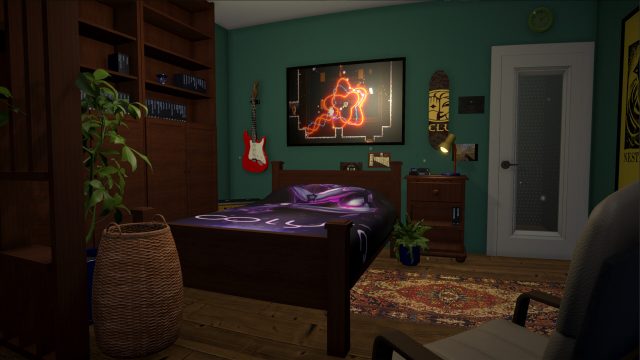
And once you’re past that hurdle, BOXROOM is still very much an Early Access game in the “please be patient with us” sense. The furniture selection is thin on the ground, doors don’t rotate so you end up building rooms around where the game has decided the exits go rather than where you’d like them, and the placement system throws up “invalid position” errors for spots that look, to my eyes, entirely valid. I’ve had boxes go missing after a save and reload, which is a genuinely horrible feeling when you’ve just spent twenty minutes getting your shelf looking right. Little things chip away at it too: playtime figures that don’t match what Steam itself reports, games landing in the wrong genre bucket, and a catalogue browser that feels like wading through treacle once your library gets past a couple of hundred titles (which, if you’re the sort of person drawn to this game in the first place, it almost certainly will).
None of that is a surprise, exactly. This is early stuff, from a small team, and the roadmap promises new rooms and furniture on a monthly drip feed between now and full release, so a fair chunk of what’s rough today could be smoothed out by Christmas. But it does mean the game right now asks a lot of patience for what should be an instantly satisfying idea. You want to boot it up, see your collection looking lovely, and have a little dopamine hit. What you actually get, for now, is boot it up, remember you need the Wizard, alt-tab out, run an executable, alt-tab back in, and then start fighting the furniture placement tool. It’s the digital equivalent of buying a display cabinet that arrives flat-packed with the instructions in the wrong language.
I don’t think it’s fair to slap a number on this one while it’s still Early Access, because the bones underneath the clunk are genuinely good, and a lot of what’s frustrating now reads like the kind of thing that gets fixed in a patch rather than baked into the foundations. If you love the idea of a shelf for your entirely-not-physical collection, and you don’t mind being a beta tester for a little while, there’s real charm here worth chasing. If you want something that works cleanly the moment you open it, give it a few months and check back in.
Leave a Reply