
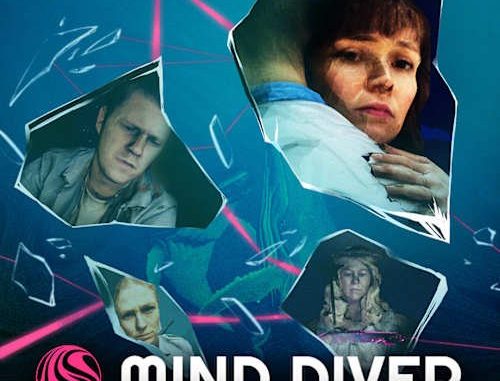
Mind Diver is one of those games that I knew very little about going in, and I think that’s probably the best way to experience it. It’s a short, unusual detective game with a genuinely interesting idea at its centre, and whilst it doesn’t quite hit all of the marks, it’s still a fun little experience.
You play as a Mind Diver, using experimental technology to enter the mind of a woman called Lina. Her boyfriend, Sebastian, has disappeared and, at the same time, Lina is rapidly losing her memories. Your job is essentially to explore what remains of those memories, repair the missing pieces and gradually work out what happened.
The way this is presented is easily one of the best things about the game. Rather than simply selecting memories from a menu, you actually swim around Lina’s subconscious, or ‘Mind Ocean’, discovering different moments from her past. It gives the whole game a strange, dreamlike atmosphere that fits the subject perfectly. If you think ‘Inception’, you’re not too far off from the premise of this game.
Once you enter a memory, you can move around, listen to conversations and inspect the people and objects around you. Parts of each memory are missing, and you have to work out what belongs in the gap. You can pick up objects, people and other details and insert them into these gaps. Get the right answer and the memory continues, often revealing another piece of the story.
I really like this idea. You actually have to listen to what people are saying and pay attention to fairly small details rather than simply following objective markers. There were a few occasions where I had to go back through previous memories because something I’d originally dismissed suddenly became important. This backtracking may annoy some, and if you’re the type of person that games while listening to a podcast or chatting to mates, this probably isn’t for you.
.jpg)
The downside is that the basic gameplay loop doesn’t really develop much beyond this. Once you understand the system, you’re essentially repeating the same process for the rest of the game. Some of the later puzzles become more involved because you have more memories and objects to consider, but I would have liked a little more variety. There were also a couple of solutions where I knew what had to go where, but I had to complete a few bits in a specific order to get to the end point.
Fortunately, the story is strong enough to carry it. What starts as a fairly straightforward mystery gradually becomes much more about the main characters themselves. You see their relationship through fragmented moments – the good parts, arguments, mistakes and things that take on a completely different meaning once you know more about what happened. As the context is revealed, by the final part of the game I was more interested in understanding the main characters’ reasoning than simply solving the case.
Visually, it’s unique. The characters and locations were apparently created using 3D scans of real actors and places, giving everything a slightly rough, almost reconstructed appearance. Initially I wasn’t sure about it, but it quickly grew on me because it feels aligned with the setting about memories and imperfect recollections. The voice acting is particularly good and it is important as so much of the game relies on listening to conversations.
It’s not a long game – and I actually think that’s a strength. It’s not quite in the realm of ‘interactive film’ but it’s certainly not a 15 hour gameplay experience.
Overall, I really enjoyed it. The puzzles aren’t always clever and the gameplay can become repetitive, but the atmosphere, presentation and story kept me interested all the way through. It’s less a traditional detective game and more an interactive psychological mystery about memory, relationships and how differently events can look once you have the full picture.
Reviewed on PS5

Leave a Reply