
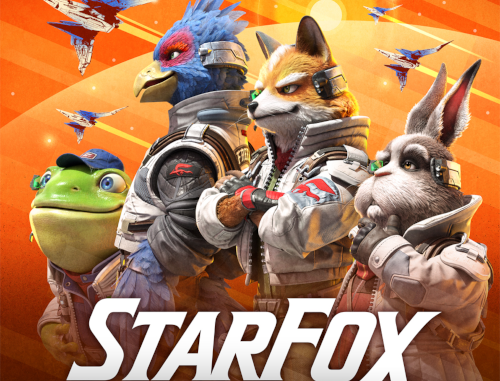
Heads up before we begin… I never played the N64 original version of Star Fox, so this isn’t a nostalgia piece and it isn’t a comparison piece either. This is just Star Fox on its own two feet, and on its own two feet it’s a really decent effort.
Built by Velan Studios, it’s a rail shooter through and through, and a confident one. You pilot the Arwing through short, tightly designed levels full of enemy waves, asteroid fields and boss encounters, swapping in the Landmaster tank for ground based stretches and the Blue Marine for a couple of surprisingly atmospheric underwater levels. The vehicle switching does a lot of work keeping things fresh across a fairly short runtime, and every level has a clear shape to it, a proper build from opening skirmish to a boss that actually tests what you’ve learned along the way.
The core toolkit is simple but well judged. You’re flying at rings mid-flight to keep your charge shot topped up, weaving through debris fields while managing when to unload a fully charged blast versus just spraying standard fire, and there’s a real rhythm to reading incoming waves and picking your moment. It’s not a complicated system on paper, but the pacing within each level makes sure you’re never just holding the fire button and coasting through.
Visually it’s really nice. The Lylat System is rendered with real personality, Corneria’s cityscapes and Zoness’s grim, polluted oceans both look like someone genuinely cared about making a rail shooter’s backdrops worth looking at rather than just something to fly past. The orchestral score backs it up nicely, and the fully voiced cutscenes and mission briefings give Fox, Falco and the rest of the crew a bit more bite than I expected from what’s essentially connective tissue between shootouts. Their bickering actually landed some jokes.
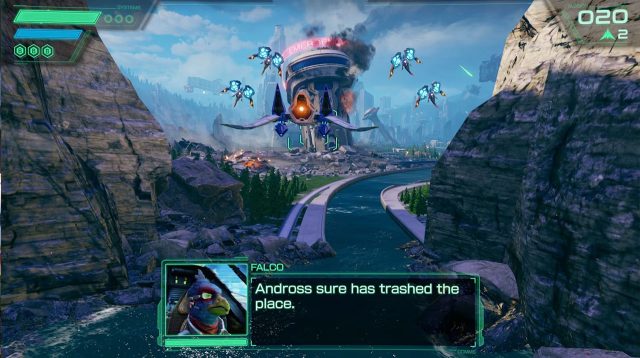
Mechanically, it’s tight. The Arwing feels responsive in exactly the way a good on-rails shooter needs to, barrel rolls deflecting fire with satisfying precision, boost and brake giving you just enough control over pacing within levels that are otherwise dictating your path for you. Branching routes reward exploring or shooting the right things mid-level, and I found myself replaying stages just to see where the other paths led, which is the sign of a rail shooter doing its job properly.
I did try the new mouse-style aiming on offer with the Joy-Con 2, mostly out of curiosity, and bounced off it within a couple of stages. It’s a neat idea on paper, more precision for the charge shot, but it fights against the flow of a genre that’s normally about reading the whole screen rather than fine aiming at one spot. Standard controls did everything I needed.
Where it lost me a bit was the checkpointing. Die partway through a level or during a boss battle, which happens plenty given how unforgiving a single hit can be, and you’re often sent back further than feels fair, redoing a stretch you’d already cleared cleanly. It’s an old-school-punishment-em-up (it’ll catch on), and while I don’t mind a game that expects precision, there’s a difference between demanding skill and just eating your time. A few more generous checkpoints would have made the tougher stages feel challenging rather than repetitive.
New content beyond the main campaign is mostly parked in the online multiplayer, a competitive battle mode with a handful of maps that’s a decent bit of extra value without being the main event. It’s the kind of thing you’ll dip into for an hour after finishing the campaign rather than something that’ll hold you for weeks, but as an add-on to a game this short, it’s welcome padding rather than filler.
At its asking price, this sits a smidge below other first-party Nintendo efforts, and given how tight and replayable the campaign itself is, that feels fair rather than steep.
If you’re after a short, sharp, gorgeous rail shooter with real personality and a soundtrack worth turning the volume up for, this delivers. Just brace yourself for the odd stage you’ll be replaying more than once.
Reviewed on Switch 2

Leave a Reply