
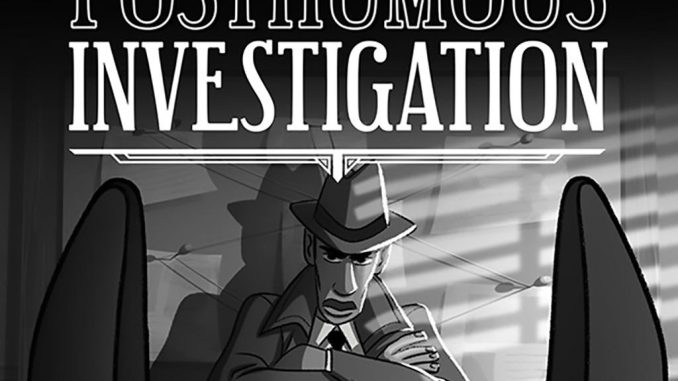
There aren’t many detective games where the client who hired you is already dead. There are even fewer set in 1937 Rio de Janeiro, based on the works of Machado de Assis, one of Brazil’s most celebrated writers. Not Sherlock Holmes. Not Agatha Christie. A Brazilian literary giant whose novels most people outside Brazil have probably never heard of. That alone deserves some credit.
You play as a private investigator who receives a letter from one Brás Cubas, a wealthy, arrogant and deeply unpopular Rio tycoon, informing you that he’s been murdered and would very much like you to find out who did it. Fourteen suspects, one day, and a time loop that resets at midnight each time you run out of road. It’s a brilliant setup, and for the first several hours, The Posthumous Investigation absolutely earns it.
Mother Gaia Studio, the Brazilian indie team behind it, have done something remarkable with the world. The hand-drawn black and white art is immediately striking, the noir atmosphere of 1930s high-society Rio is beautifully realised, and the writing weaves in characters and details drawn from Machado’s other works, like Dom Casmurro and The Alienist, in a way that makes you want to actually go and read them afterwards. You’re piecing together a proper web of grudges, secrets and motives, and for a while it feels like a genuinely brilliant clue-chasing-and-gradually-crumbling-em-up (it’ll catch on).
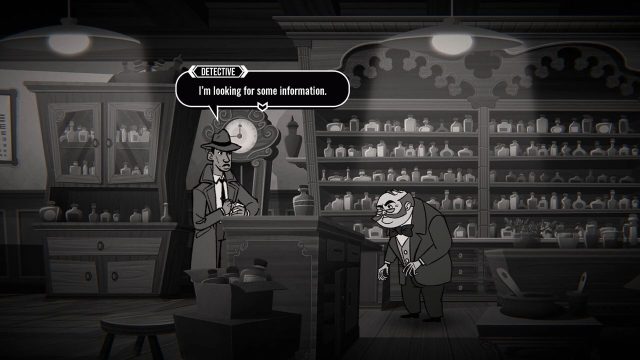
There are a couple of grumbles. The game markets itself as light on hand-holding, which isn’t entirely honest. Every time you reset your loop, Brás Cubas pulls you into a debrief and walks you through your evidence, more or less telling you what to do next. Your clue tooltips chip in too, as do your suspect profiles. I ended up deliberately ignoring Cubas and skipping my own notes just to preserve a bit of detective agency, which is a mildly odd thing to have to do in a mystery game.
The back half also leans into repetition more than it needs to. What starts as an atmospheric whodunnit gradually becomes a run-across-town-and-show-someone-a-piece-of-paper-em-up (it’ll catch on, probably). There’s one particular alley you’ll visit so many times you’ll start mentally furnishing it. The time loop is a genuinely clever mechanic, and the game mostly uses it well, but by the final few hours it starts to feel a little more like a commute than a puzzle.
Neither of those things undoes what The Posthumous Investigation gets right, and it gets a lot right. The setting is wonderful, the premise is one of the most original in the genre in years, and the literary angle gives it a flavour you won’t find anywhere else. There’s real craft here, and a genuine passion for the source material that comes through in every scene.
If the idea of a noir mystery set in 1930s Brazil, built on books you’ve probably never read, sounds like exactly your kind of evening, it almost certainly is.
Reviewed on PC

Leave a Reply